
Checking Criminal History in New Orleans
Start with the record that answers the question. New Orleans has no single public screen that combines every police report, booking, city charge, state case, and Louisiana repository event. Use exact item, booking, or case numbers when known, and confirm same-name results with dates and court details.
- Request a New Orleans police narrative from NOPD. Give the item number, date, time, location, record type, and involved role.
- For current jail custody, search OPSO Inmate Query, then use the jail phone route or Magistrate Court List if the embedded interface fails.
- Take municipal ordinance and traffic questions to New Orleans Municipal and Traffic Court. Search state felony and qualifying misdemeanor minutes through Clerk Connect or Docket Master.
- Obtain filed documents or a certified disposition from the correct clerk. Online minutes help locate a file but are not certified records.
- For one's own statewide Louisiana history, use LSP Right to Review through LAPS. After transfer, use LA VINE or the DPS&C locator.
One City, Several Record Keepers
New Orleans is the only incorporated municipality in Orleans Parish, and the city and parish are geographically coterminous. That does not create one records office. NOPD holds city police reports. OPSO holds jail and booking records. Criminal District Court keeps state criminal cases, while Municipal and Traffic Court keeps its own docket. The public defender and district attorney occupy separate roles and do not replace either clerk.
The compact justice corridor can be misleading. Criminal court and clerk functions are at 2700 Tulane Avenue, Orleans Justice Center is at 2800 Perdido Street, and Orleans Public Defenders is at 2601 Tulane Avenue. Municipal and Traffic Court sits at 1601 Perdido Street. NOPD records production is tied to South Broad. A short walk between buildings does not merge their databases.
New Orleans Police Department Records
NOPD's Records and Identification Division includes Public Records, Criminal Records and AFIS, Expungement, Subpoena, and Special Officers functions. Public Records handles releasable police and accident reports, letters of good conduct, and local checks. Criminal Records operates fingerprint identification. The Expungement Unit implements court orders, while specialized production routes through the Subpoena Unit.
The official NOPD Records and Identification Division explains those named units. The manifest capture below shows the city office source behind this records structure.
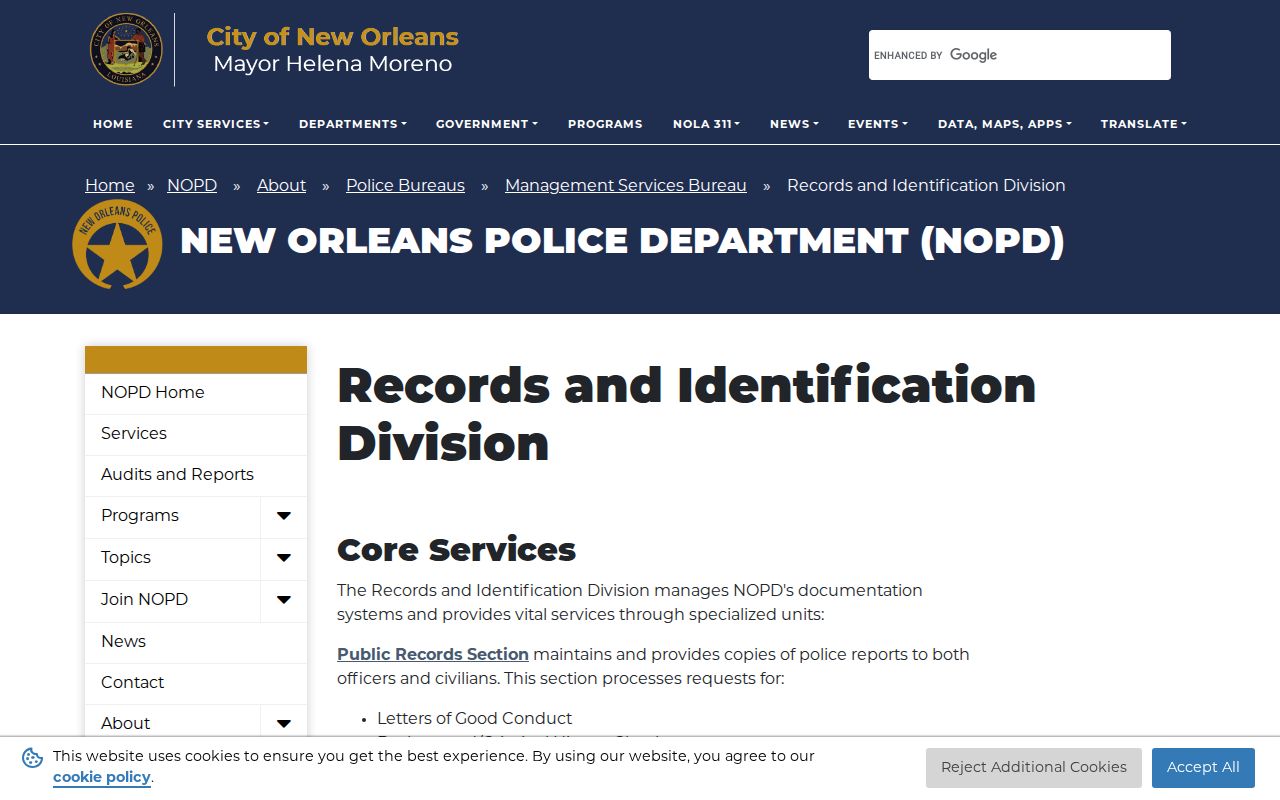
The division is the right starting point for NOPD-created material, but it cannot certify a court disposition or supply an OPSO booking file.
Requesting New Orleans Police Records
A useful NOPD request describes an existing record instead of asking staff to conduct open-ended research. Avoid “any and all.” NOPD assigns a Record Room Number for later correspondence, processes requests in order, and publishes a 30-day target. Review with the district attorney or city attorney can add weeks. NOPD does not transcribe recordings.
| NOPD Request Field | Type | Need | What to Enter |
|---|---|---|---|
| Requester/contact | Text | Required | Contact details for notices and delivery |
| Record/item number | Text | Strongly recommended | The NOPD incident identifier |
| Incident date/time | Date or text | When known | A narrow event window |
| Location | Text | When known | The event location |
| Record type | Selection or text | Required | Police, accident, 911/CAD, video, or another existing record |
| Description | Long text | Required | Specific documents, not broad “any and all” language |
| Delivery/inspection | Choice | Optional | Available portal options and fee preference |
| Attachment | Upload | Optional | Subpoena, authorization, or item list |
| Submit | Button | Required | Retain confirmation and Room Number |
Note: Body-camera, 911 audio, juvenile, victim-sensitive, and active-investigation records may require legal review and redaction before release.
New Orleans Arrests and Bookings
NOPD arrestees are generally taken to OPSO at Orleans Justice Center, not a separate NOPD city jail. The NOPD item or arrest report describes the police event. OPSO creates the booking identifier and current-custody record. Magistrate and Docket Master entries can then show probable-cause, bond, and court events. A person may be released before a portal search, and the charge may change during prosecutorial screening.
Other agencies complicate the path. Harbor Police, Louisiana State Police, campus departments, levee police, and federal agencies can make arrests within New Orleans. Request the narrative from the agency whose badge generated the item number. OPSO may still hold the local booking. For the detailed jail trace, use the Orleans Parish arrest lookup.
Choosing the New Orleans Court
Municipal ordinance and traffic matters belong with Municipal and Traffic Court. State felonies and qualifying misdemeanors belong in Criminal District Court unless another court has jurisdiction. Louisiana does not use a simple universal class grid. A felony is an offense punishable by death or imprisonment at hard labor; other offenses are misdemeanors, but the charging authority and statute still determine the correct court.
Use the filed count, not only the booking label. The district attorney may refuse, divert, amend, file a bill of information, or seek an indictment. Municipal matters can involve the City Attorney. For a prosecutor-name inquiry, the city requests the party name, division or section, and case number when available. Juvenile records are not an ordinary public name-search channel.
Municipal Court Records in New Orleans
New Orleans Municipal and Traffic Court handles city ordinance and traffic matters at 1601 Perdido Street. Its main phone is 504-658-8500, and municipal-case inquiries may use 504-658-9700. Direct questions to this clerk instead of Criminal District Court when the allegation is municipal or traffic based.
| Court Name | Municipal and Traffic Court of New Orleans |
|---|---|
| Case Types Heard | Municipal ordinance and traffic matters within the court's jurisdiction |
| Case Lookup Channel | Court service channels, clerk counter, and the municipal inquiry phone path |
| What the Docket Shows | Party and case identifiers, section, allegations, settings, minutes, and outcome when public |
| Copies & Fees | Request an existing record from the clerk and confirm current copy or certification charges before ordering |
Where New Orleans Records Go
A New Orleans enforcement event can produce multiple linked records without becoming one unified public file. NOPD or another arresting agency creates the report. OPSO creates intake data. A magistrate reviews probable cause. Prosecutors decide whether and where to file, and the correct clerk records the case. Fingerprints and later dispositions may reach LSP's Louisiana Computerized Criminal History repository.
Record flow: New Orleans Police Department › Orleans Parish booking and courts › Louisiana State Police BCII
Search near the event for a police report or booking. Search the clerk for filed counts and disposition. A Louisiana Right to Review is the authoritative route for a person inspecting their own statewide repository record, while LA VINE covers later custody or supervision.
CASTNet Is Not Public Records
New Orleans introduced CASTNet for police use in 2019. The system replaced an older police query tool and combines local and state criminal-justice information with Criminal District Court and Municipal and Traffic Court data for authorized officers. That integration can make the system sound like a public New Orleans criminal-record portal, but it is law-enforcement infrastructure. Members of the public cannot use CASTNet to bypass the separate custodians.
Use NOPD's request channel for a city police report, OPSO for booking and current custody, and the correct court clerk for filed charges and disposition. A person seeking their own Louisiana repository history should use LSP Right to Review. Old official pages or portal labels can also lag institutional change, especially after the 2026 restructuring of Orleans criminal-clerk functions. Follow the current court and clerk links rather than relying on an old title.
Reading New Orleans Crime Data
NOPD publishes calls for service, reported offenses, Uniform Crime Reporting tables, and interactive mapping. Each source measures a different event. A call is a request for response and may be duplicate or unfounded. A reported incident reflects an agency classification. An arrest reflects enforcement, while a court filing reflects prosecutorial screening. A conviction requires adjudication. These counts should not be treated as interchangeable.
Use a year-stamped dataset and record the extraction date before quoting a number. New Orleans neighborhoods such as the French Quarter, Central Business District, Mid-City, Gentilly, New Orleans East, Algiers, and Uptown are not separate municipalities. Police districts and neighborhood boundaries do not create separate city courts or records systems. Port activity, universities, festivals, and levee operations do add agencies, so identify which badge or unit generated the incident number before sending a request.
Note: An official crime map provides event context, not a complete list of arrests, filed cases, or convictions.
New Orleans Public Records Portal
The city portal routes requests by department. Choose NOPD for city police records, not OPSO jail files or court minutes. Include the narrowest useful identifiers and ask for inspection or a fee estimate if cost matters. Save the submission confirmation because later communication may depend on the assigned tracking details.
The City of New Orleans public-record request portal is the manifest source for that routing channel. Its capture appears below.
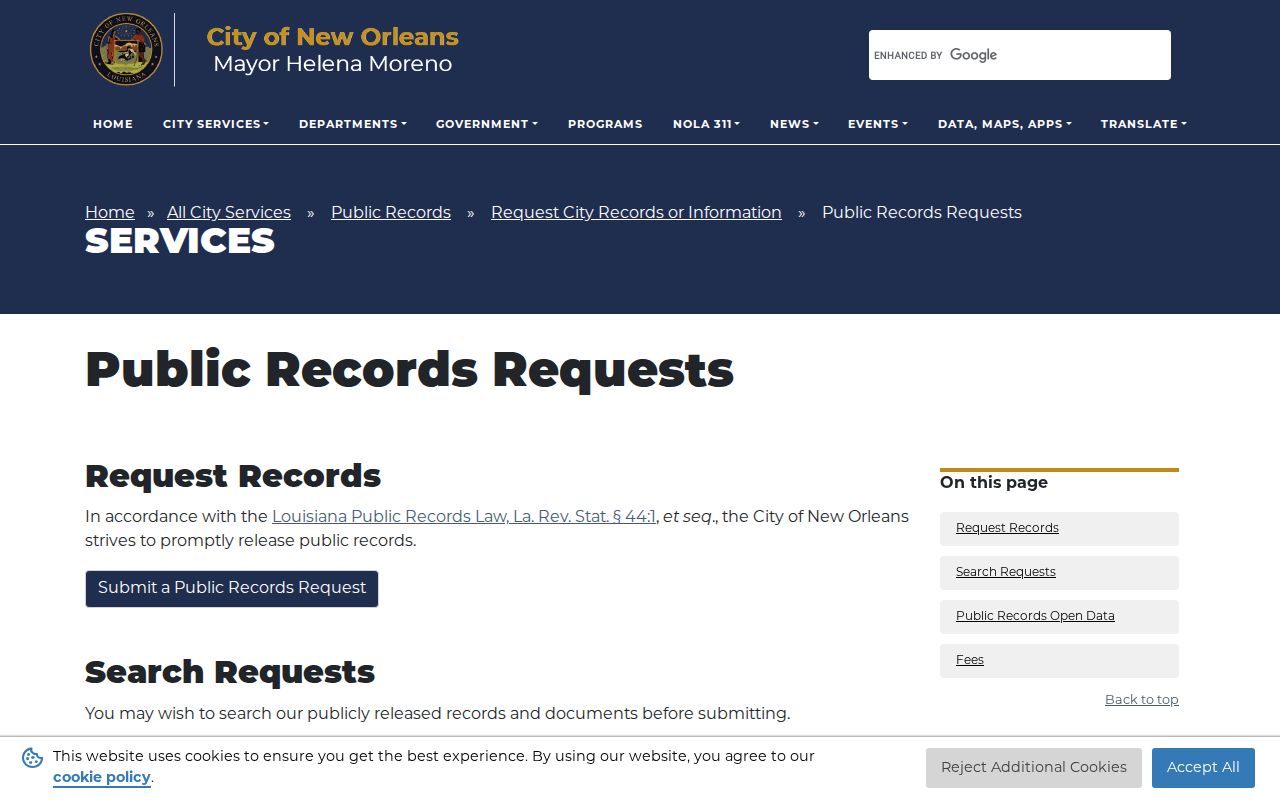
The portal is a request route, not a searchable criminal-history database. The custodian still reviews access, redactions, format, and any lawful reproduction charge.
New Orleans Public Defense Records
Orleans Public Defenders serves appointed clients from 2601 Tulane Avenue, Suite 700, New Orleans, LA 70119. Its phone is 504-821-8101. The office is part of the local justice system, but it is not a public criminal-history database and does not replace the court clerk, NOPD, OPSO, or the district attorney as custodian of their records.
The Orleans Public Defenders contact page supplied the successful manifest image below.
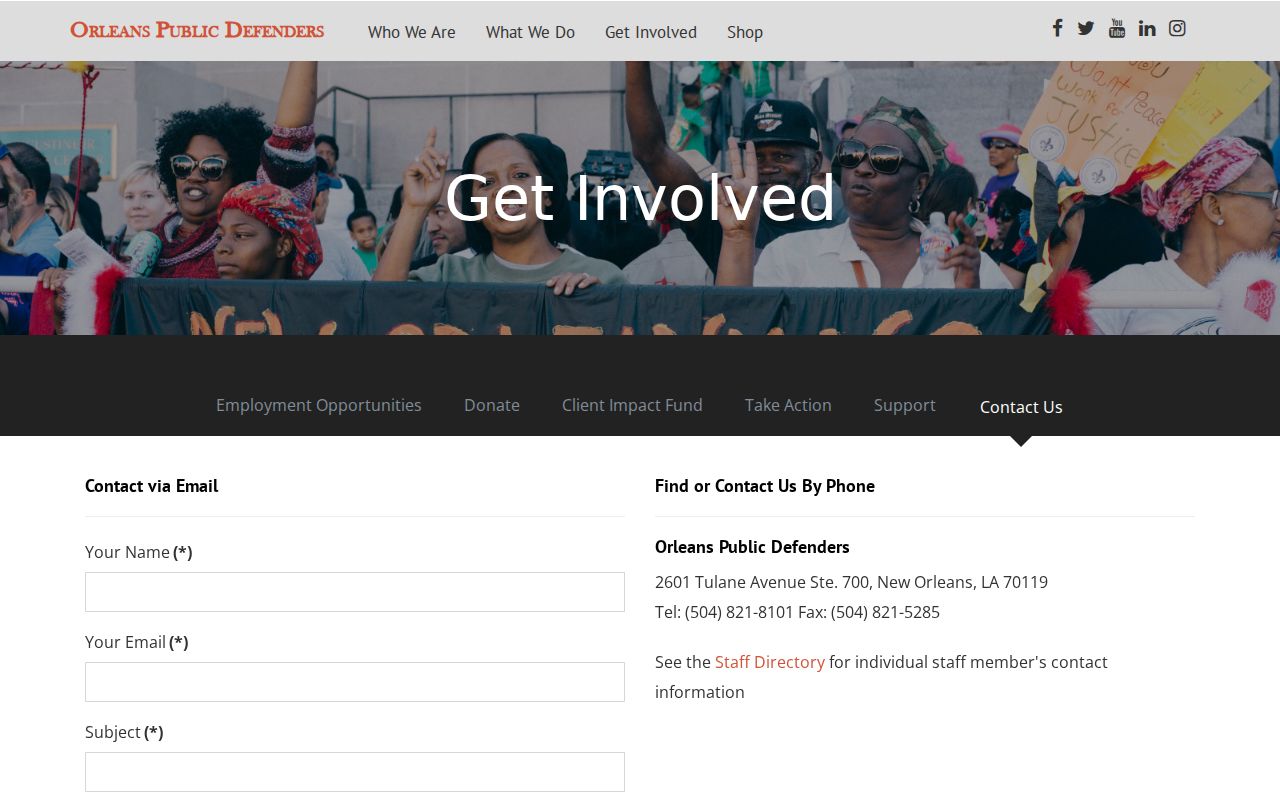
Contact the defense office about its representation, but obtain public docket entries and certified outcomes from the court that handled the case.
New Orleans Records After Katrina
Hurricane Katrina severely disrupted New Orleans courts, detention, and public defense. The system rebuilt with electronic tools such as Clerk Connect and Docket Master, along with a transformed full-time public defender office. That history explains why a modern online minute entry may coexist with older paper material, transferred custody, or an office whose title has since changed. For an older New Orleans criminal record, begin with the present custodian and provide the exact case, item, or booking number rather than assuming the current portal contains every historical document.
Orleans Justice Center has also operated under a federal consent decree since 2013. Court and monitor reports address system-level staffing, safety, medical and mental-health care, classification, use of force, and physical plant. They can explain institutional conditions, but they do not make individual health, housing, classification, or security files public. The 2025 jail escape prompted further security and technology scrutiny. Use dated official reports for those reforms and keep individual criminal-record requests with the office that created the underlying file.
Public Access Rules in New Orleans
Louisiana law favors access to identifiable public records, but it also protects active enforcement material and sensitive data. Ask the custodian to separate releasable portions when redaction is possible. Police intelligence, confidential sources, security procedures, juvenile facts, victim identifiers, medical data, and sealed or expunged material may remain outside public view.
Key Statutes:
Louisiana R.S. 44:31 establishes the general right to inspect or copy public records.
Louisiana R.S. 44:32 governs request mechanics and reasonable identification of records.
Louisiana R.S. 44:3 protects specified law-enforcement and active-investigation material.
Louisiana R.S. 15:579 restricts dissemination of juvenile criminal-conduct records outside criminal justice.
Expungement restricts qualifying records from public access but does not physically destroy every authorized copy. NOPD reports that implementing an adult Orleans order commonly takes six to eight months, with clearing across agencies taking up to twelve months.